









In 490 BC a giant Persian army invaded the small town of Marathon near the coast of Greece. However in the Battle of Marathon that ensued, the Greek army defeated the Persians, and a messenger named Pheidippides was sent to Athens to bring news of the victory. The young Greek ran the 42 km from the battlefield to the capital as fast as he could, announced his joyous message, and died. And according to folklore, this is the inspiration for the marathon race we know today. Apart from the obvious connection to the legend of Pheidippides, the Athens Classic Marathon is dedicated to Gregoris Lambrakis, a Greek athlete and Member of Parliament who, after his politically motivated assassination in 1963, became a national symbol of democracy and social justice.
The history of the Athens Classic Marathon doesn’t go as far back as the history of the marathon distance itself. The 2010 version, run on 31 October, celebrated the 2500-year anniversary of the Battle of Marathon in 490AD. Fittingly, both the male and female race records were beaten on this day. In 2011, the race was held on 13 November and it was the 29th version of the Athens Marathon. So far, the marathon field has consisted of 4,000 or so runners; a relatively small field which still allows for marathoners to enjoy the uniqueness of running with 2,500 years of history under their feet. The 30th anniversary edition was held on 11 November 2012.
However, the 2010 anniversary race saw a record number of more than 12,500 runners flock to the race. For runners who wish to experience a little history in the city that gave birth to western civilization, but don’t fancy a 42km run in hilly Attica, the Athens Classic Marathon also features a 5km and 10km run – both starting and finishing in the Panathinaiko Stadium. In addition to this, it is possible to walk the entire marathon route if you start two hours before the runners begin.
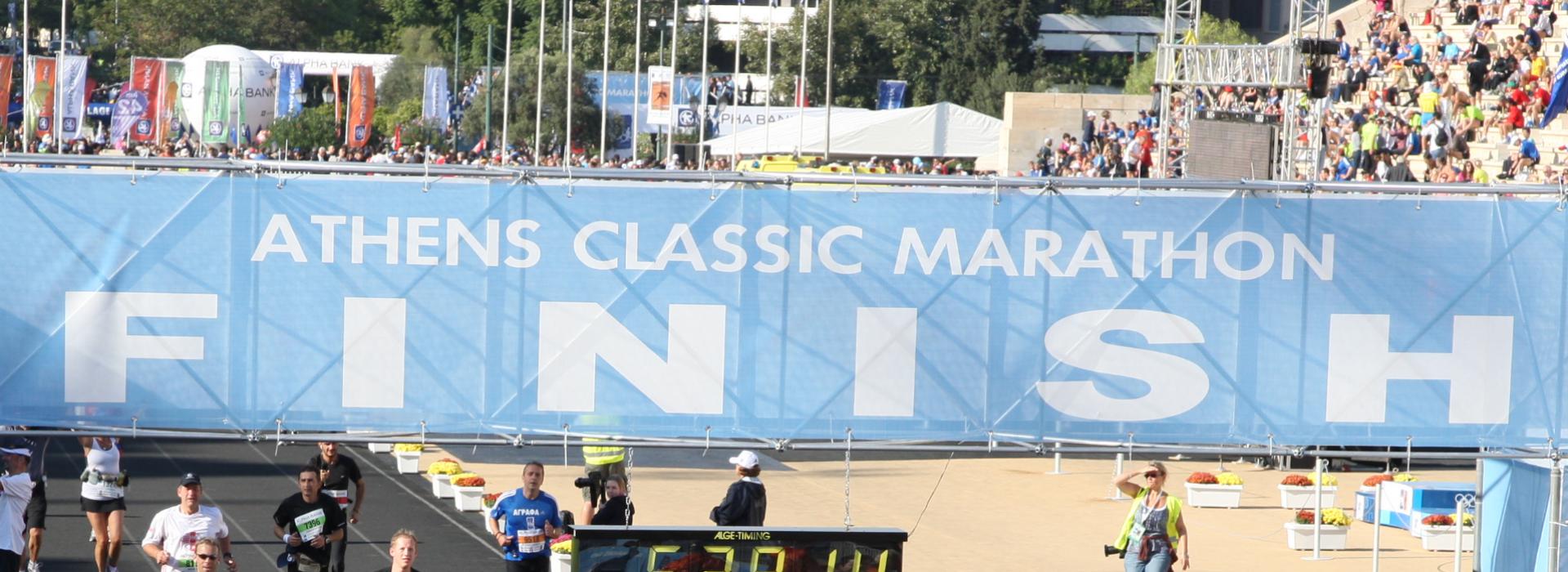
The Athens Classic Marathon probably isn’t the best race to go PB hunting, as the course is rather challenging with the start line near the sea and the finish line in central Athens at 110m above sea level. Along the way, runners will have to climb a number of hills, including the base of Mount Pendeli. The marathon ends in the Panathinaiko Stadium built entirely in white marble for the first modern Olympics in 1896. The marble stadium is located on the same spot where remains of an ancient stadium used for the original Olympic Games in ancient Greece were excavated. So what the course lacks in flatness, it certainly makes up for in historic significance. The Athens Marathon is one of the most popular marathons in Europe and by far the most popular run in Greece. Registration for the marathon in Athens? Follow the links below.
You will find registration information for the marathon in Athens, Greece, here.
Athens Classic Marathon Course
The course of Athens Classic Marathon gives you the possibility to challenge yourself and be part of history at the same time. Click here for course map and elevation profile.