

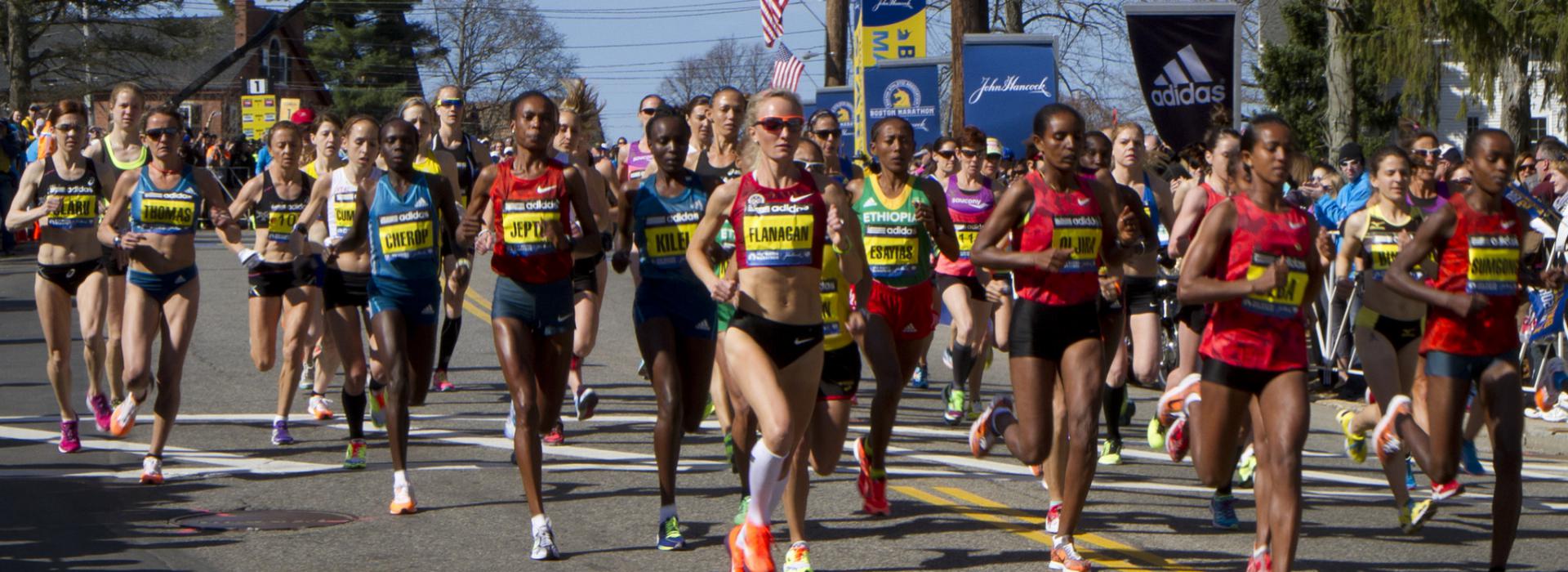
In this first version of the Boston Marathon only 18 runners entered the race, but the number of participants has increased steadily since then. The largest field of runners so far was in 1996, when over 35,000 people finished the 100th Boston Marathon. The 2011 Boston Marathon on 18 April 2011, attracted 26,895 entrants and about 500,000 spectators.
The Boston Marathon ranks as one of the most prestigious running events in the world, thanks to the long history of the race, the challenging course and the fact that you have to qualify to register as an official participant. In order to qualify, every runner must have finished a certified marathon within a certain timeframe determined by the age of the runner. The qualifying standard is high enough to make qualifying for Boston – also known as ‘to BQ’ – quite an achievement in itself. An overview of qualifying times divided into age groups is available here.
The legendary course of the Boston Marathon has been the same throughout most of the history of the race. The route follows 42.195km of winding roads from rural Hopkinton to urban Boston, and it is renowned for its level of difficulty. Shortly after the 25km mark, the road starts going up a series of hills, named the Newton Hills. These hills never reach truly high elevations, but their position after 25km of downhill running, when glycogen stores are likely to have run out, can break even the toughest runner. The last of the four hills is known as Heartbreak Hill. This hill does not, as one may think, get its name from the many runners being heartbroken from the fact that they have to conquer yet another ascent, but the name does originate in the Boston Marathon. In the 1936 race defending champion, John A. Kelley, caught up with race leader, Ellison ‘Tarzan’ Brown, giving him a consolatory pat on the shoulder as he passed him. This overbearing gesture apparently gave Tarzan supernatural strength, and he went on to win the race in front of Kelley. In the words of a local journalist, the outcome of this act of nemesis ‘broke Kelley’s heart’.
The hilly course at Boston also played a part in making the 2011 race the fastest marathon ever. Geoffrey Mutai and Moses Mosop of Kenya benefited from a fortunate tailwind and the downhill slope of the course to finish in the fastest times ever recorded. Mutai finished in amazing 2:03:02, just four seconds ahead of Mosop. However, due to the nature of the Boston course, the IAAF does not recognize it as eligible for records, and thus Mutai's impressive run is not accepted as an official world record. That record still belongs to Haile Gebreselassie who won the 2008 Berlin Marathon in 2:03:59.
The Boston Marathon is one of five members of the World Marathon Majors, consisting of marathons in Berlin, Chicago, London and New York, apart from the one in Boston. For registration in the Boston Marathon and further information, please follow the link to the official site here.